A Trip to Fort Wishniak
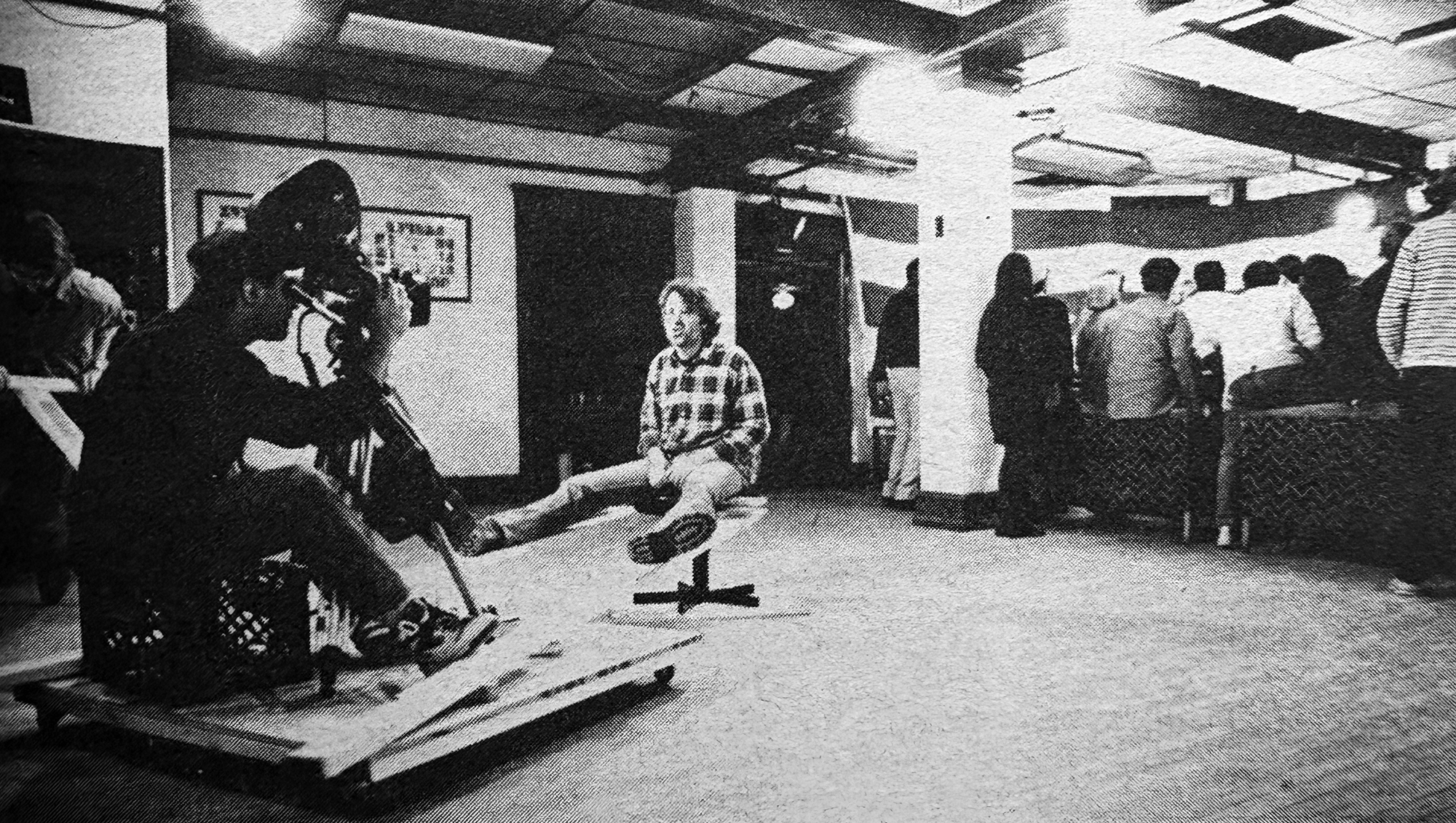
Wishniak’s lead singer James Hostetter during the filming of the group’s video. (Photo by Ed Cunicelli)
By MIKE BRENNER
Big Shout Magazine, January 1990
“Being in a band is like being in the most exclusive boys club,” says Dave Frank, drummer for Philly’s Wishniaks. “It’s like having a tree fort. You analyze and over analyze every little thing. ‘Should we play this house party or is it too close to when the record is coming out?’ It gets terrible sometimes. There are just as many insecurities and unknowns as with a boyfriend or girlfriend. It’s just as weird.”
“There’s a lot of stress involved,” agrees bassist Jim Moran. “I’m constantly trying to judge whether I feel like it’s still creative or whether it’s still progressing or if it’s still fun. There are always doubts when things aren’t going especially well.”
While it sounds by these comments that the Wishniaks are contemplating an end to their music making, it’s really just the opposite. The band is just about to release their best recording ever, start a tour and strengthen their already enviable position in the Philadelphia scene. Why the downbeat talk then?
“I think when a band starts to reach new levels, suddenly new problems present themselves,” says Andrew Chalfen, Wishiak guitarist and primary songwriter. “I think sometimes we felt that if we got to this level or that level with the band, everything would be wonderful from then on, but there’s always somethign else to give us angst.”
The Wishniaks seem to be caught in a position that many rising bands find themselves — playing enough that day jobs become a major hindrance, but not playing enough to be self supporting. Moran agrees:
“We’re kind of stuck in between being four friends in a band who play occasionally and…”
“… guys who have day jobs and are cranky when they come to practice,” interrupts Chalfen.
“We’re in a limbo period,” concludes Moran.
While the goal of not having to keep day jobs is a point of consensus within the band, there are differing attitudes about the exact meaning of success. Every band wants some measure of success, some sign that the players’ work is being heard, bought or appreciated. The Wishniaks seem to be struggling with what they would be willing to give up for that kind of adulation.
“We don’t know what we’ll have a say in if we get to the stage where we don’t have to work,” says Chalfen. “We don’t know what the future looks like. We have some theories. What’s it like out there? We don’t know. Will we be happy? Will we have artistic say? Will we get screwed by our record company? Will all our hopes and dreams come true?”
“Probably not,” Frank answers dryly.
When it comes to hopes and dreams, the band’s members still find both words and agreement difficult.
“We all have hidden agendas that are unknown to everyone,” says James Hostetter, singer/guitarist. “I think we’re kind of repressed people, too. We have these agendas, and when things aren’t going along with them — musical agendas or business decisions — we bottle up our comments and wind up exploding later on.”
“Sometimes I think about the old days,” Franks says, staring into his mug of beer. “I mean, we were so bad then, when had no expectations. At this point, after three years, it would be a shame to break up or not making another record.”
“We’ve created a machine that kind of lives by itself,” says Chalfen with a mix of both awe and dread.
The band has been undergoing changes in their artistic machinations as well. as the members of the Wishniaks get better on their respective instruments, the methods of songwriting have progressed as well.
“Up until this album, I’ve been the main writer,” says Chalfen with a hint of hesitation, “But… I’ve been trying to step back from that role.” Singer Hostetter contributed lyrics to two songs on the new LP.
The fact that Hostetter sings Chalfen’s lyrics the majority of the time, while working very well for the most part, creates its own set of problems.
“I tend to write songs along more metaphorical lines,” says Chalfen. “And James tends to go for a more literal feel. So sometimes he’ll sing the lyrics without complaint, sometimes with complaint and sometimes he won’t sing them at all.”
“That only happened just recently,” Frank interjects. There is a pause in the conversation. Moran volunteers the explanation.
“Right now, we’re not doing our best new song because James won’t sing the lyrics and Andy feels very strongly about them.”
Hostetter shrugs, takes a sip of beer, smiles and says, “It’s not my fault.” The tension is broken. The conversation rambles on.
Despite these problems and inner struggles, it is obvious that these four are united by the very music that threatens to drive them crazy. They try to see which records they all share in common (Zeitgeist, dBs, Huser Du, and others) They recollect the days when Chalfen, Moran, and Frank all worked as DJs at WXPN.
“I first talked to James when he called up and won tickets to the Zeitgeist show,” remembers Frank, laughing.
“And he heard my very first show,” Chalfen joins in.
“We all used to go see every show then because we could go for free,” says Moran, who besides spinning discs, also booked shows at Penn and some Penn frats.
The stories flow out of the four Wishniaks in a constant stream, not with a feeling of nostalgia, but more of relief. Old bands, show they all saw, favorite places to play, the Philly scene, and friends who have left town all mesh together in a giant picture that shows not only how far they have come but how much they have all grown.
“Andy used to wear mountain boots onstage because he was shaking so much,” laughs Moran. Chalfen sheepishly validates this story.
“Our first and best compliment was when two Mormon college students came up to us while we were practicing in some hall and said we sounded like the Plimsouls,” recollects Moran, a grin on his face. “We thought that was great, wo we invited them to see us at Bacchanal, which is pretty funny — Mormons and Bacchanal!”
It’s been a long trip for this guitar pop band.
It’s a Sunday afternoon at Pi Lam, a Penn frat where Moran used to book shows. The room where the bands usually set up is littered with equipment: amps, guitars, drums, lights, cameras, and speakers.
The Wishniaks are holding their instruments, lip synching to a song from their new album, Catch 33. They’re filming their first video. Thirty to 35 dancers are assembled in front of the band, ready for their cue.
Suddenly, out of the sound system comes a song roaring with ferocity, unlike other Wishniak recordings. It has almost a Ramones feel about it and a guitar sound that eats the Wishniaks previous album, Nauseous and Cranky, for breakfast. This, if anything, will silence any comparisons to the dBs or Beatles or any band having anything to do with “jangle.” This rocks.
The dancers throw themselves about, only to be disappointed when the director cuts the action.
With the release of Catch 33 and a tour of the U.S., it seems the Wishniaks may have to start coming down to brass tacks as to what they do want out of the band. It may be time to put aside the doubts and re-string the guitars; and when the future finally arrives, it may just be time to very carefully climb down from the tree fort.