I Was a Teenage Extra for America’s Most Wanted
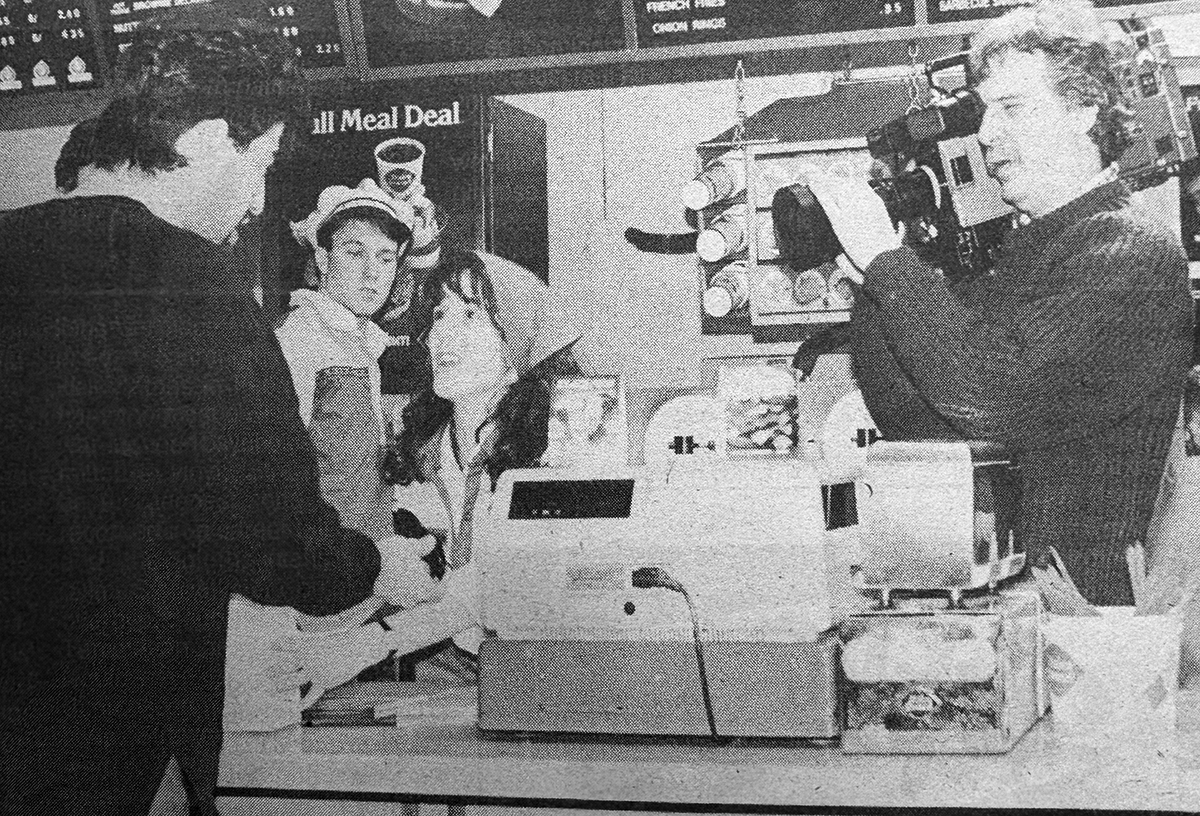
CAN I HAVE SOME FRIES WITH THAT SHAKE? The America’s Most Wanted crew simulate Charles Cohen’s ill-fated trip to a Phoenix Dairy Queen at a D.Q. in New Castle, DE. (Photos by Dave Hamill)
By DAVE HAMILL
Big Shout Magazine, March 1989
I hadn’t intended to spend my Friday night at a Dairy Queen in New Castle, DE, particularly not a Dairy Queen in New Castle that was pretending to be a Dairy Queen in Phoenix, Arizona.
But hey, Hollywood calls.
Actually, it was New York calling — the crew of Fox Broadcasting’s America’s Most Wanted to be exact. And it wasn’t exactly a call, either. It was more like a “Hey, you go stand over there and pretend to be a customer!”
Perhaps I should explain. My unexpected brush with television stardom came courtesy of Charles Cohen, the University of Delaware’s most infamous freshman, who is currently under suspicion in the stabbing deaths of his parents, Martin and Ethel, last November. Nobody is quite sure where Charles is right now, but the New Castle County Police — not to mention the FBI — have developed more than a passing interest. And in January, so did the America’s Most Wanted people.
For the uninitiated, America’s Most Wanted (henceforth to be referred to as AMW) is a half-hour program which airs Sunday evenings at 8 p.m. on the Fox Network (locally, that’s Philadelphia’s WTXF, channel 29… or channel 4 for you Heritage subscribers). Its goal is to aid law-enforcement authorities in the apprehension of suspected felons who have taken their show on the road; in other words, the folks whose pictures you might notice hanging from the post office wall when you stop in to buy stamps.
In effect, AMW turns the whole U.S. of A (or at least a modest percentile of it) into a giant town watch community. Viewers watch a recreation of the crime in question, get the lowdown on any physical or behavioral quirks the perpetrator may have, and are instructed to contact the show’s Washington D.C. hotline or local police if they think they have information as to his or her whereabouts.
If you’ve never watched it, you may be tempted to lump AMW in with the horde of “shock & schlock” programs currently filling TV screens from Fresno to Fenwick Island. But there are at least two good reasons why that’s not a fair assessment.
The first is the program’s host, John Walsh, an advocate for victims’ rights whose tragic story was made into a TV movie called Adam, starring Daniel Travanti. Walsh, whose son was kidnapped and later killed several years ago, uses his instant credibility and no-nonsense style to give the show an air of respectability lacking in other examples of this genre.
Even more impressive is the bottom line: AMW gets results. Nearly half of the cases dramatized in the show’s first year have produced apprehensions, with 60% of these coming as a direct result of viewer tips. Suddenly, local police departments are becoming very receptive to the show’s advances — and in several instances, have even initiated contact themselves in hopes of bringing a speedy end to a particularly baffling case.
All of which brings us back to January, when the producers of AMW decided to investigate the strange and colorful case of Charles Cohen. This one seemed to have all the trappings: the suspect was accused of killing his own parents — not just killing them, either, but stabbing them repeatedly. Not only that, but his father was also a “respected member of the community,” the director of the Delaware State Hospital. This was an apparent classic case of a pampered youth gone bad, with a traceable moral descent that included sex (a stint as a male stripper), drugs (a cocaine addiction) and — Tipper Gore, take note — rock ‘n’ roll (he was a member of an Illinois punk band called Bourbon & Chlorox before moving to Delaware and running with Jerry Lehane III for a short while — see more about that >>>). Why, the kid even had a funny haircut!
After some initial reluctance, the New Castle constabulary agreed to participate in the AMW recreation. A month’s worth of research ensued, and on February 6 the entire crew (a mere handful, actually) descended on Newark to scout locations and hire actors to flesh out the cast. Filming began two days later.
I contacted the segment’s producer, Julie Harman, upon her arrival in Blue Hen country. I wasn’t sure what my angle was, but I was hoping to sit in on a couple of on-location shoots and take it from there. It was during this initial conversation that I was invited to the fateful Dairy Queen, where I would be “discovered.” If only I had known, I would have spent more time on my make-up.
But life rarely lets you read the script in advance, so there I was on the evening of February 10 in my sneakers and jeans, trying to stay out of everyone’s way, when Harman suddenly decided that the D.Q. should have a couple of customers in it when Cohen made his entrance. There was a moment of awkward silence as everyone looked to their left, then their right, searching for someone who didn’t have behind-the-scenes responsibilities.
Almost simultaneously, all eyes fell on me. “Hey, Mr. Reporter,” Harman called out from the other end of the counter, “how’d you like to be on TV?”
So that’s how it happened. It was all so fast I didn’t even have time to get into character; you know, examine my motivation and all that stuff. But I think I did OK. I mean, when Cohen ordered a bunch of food and tried to trade his sunglasses for it because he had no money, you could just see the incredulous look on my face. And the way I shook my head in amazement and disgust when he stormed out the door after the D.Q. employee told him to get lost… well, I’ll let the critics decide.
It didn’t even matter that I was wearing a winter jacket in a scene that was supposed to take place in Phoenix. My performance transcended temperature.
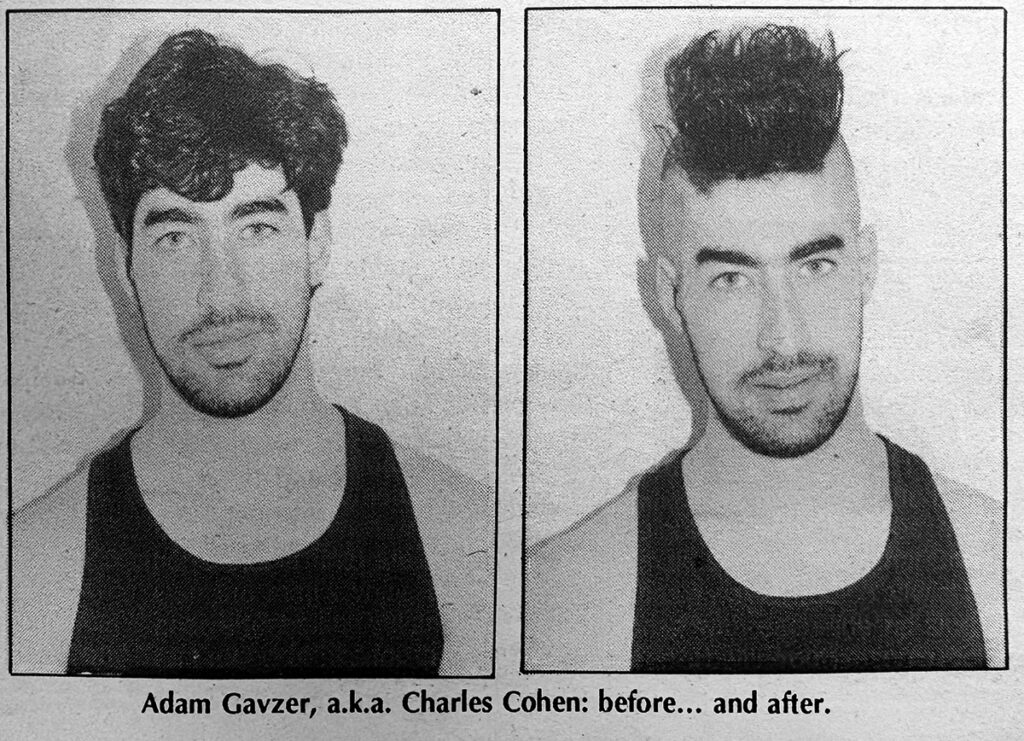
When it was over, I still hadn’t interviewed anyone, and everybody was hot for their respective hotel rooms and a good night’s sleep. But since I was one of the gang now, I was more than happy to accept their invitation to the next night’s shooting in Newark, where Adam Gavzer, the New York actor portraying Cohen, was to get a Mohawk before the cameras.
When I arrived at the appointed address, I knew I was in for a good time. There was plenty of Chinese food in the kitchen, the atmosphere was much more relaxed, and everyone was willing to let me ask them questions and/or take their picture. I spoke with Harman over sweet-and-sour pork, learning quite a bit about how AMW works in the process. Then it was moo-goo gai pan with the production manager Mary Ellen Iwata, a veteran freelancer who previously spent seven years as executive producer of Evening Magazine in Baltimore. Tea for two was shared with Kara Biasotto, a hairstylist at Headlines in Newark who had been commissioned to mow the hawk; and I munched a fortune cookie as U.D. student Lee Harting explained how he had been chosen to serve as Iwata’s production assistant.
By the end of the evening I was no longer hungry, Gavzer had a haircut only a mother could love, and the crew of AMW was one day away from wrapping up their stay in Delaware. Unfortunately, I was unable to attend the final shoot at the Deer Park, but I felt I had gotten plenty of material with which to write a story. I had even figured out my angle: “I Was a Teenage Extra for America’s Most Wanted.”
The segment on Charles Cohen was televised on February 26 — an impressive two-week turnaround — and as of this writing, he is still at large. Based on the statistics, there is now a 50/50 chance that someone, somewhere will recognize Cohen and place a phone call to the authorities that will lead to his arrest. If this happens, the crew told me, they will feel like they played an important part in it.
And thanks to a Dairy Queen in New Castle, I will too.
Editor’s Update: While on the lam, Cohen traveled to San Franciso where he was befriended in February 1989 by businessman Conrad Lutz, a vice president of Wells Fargo Bank.
Cohen lured Lutz into his apartment for a sexual encounter but stabbed him to death instead.
Cohen’s story was featured twice on “America’s Most Wanted,” which may have prompted him to flee California after killing Lutz. He resurfaced a year later in New Orleans, where he was arrested and charged with mugging a woman while attempting to avoid paying a taxi fare.
At a hearing before a Louisiana judge, Cohen unexpectedly revealed his true identity and confessed to the three murders (both of his parents and Conrad Lutz). After being extradited to Delaware in 1992, he was sentenced to two life terms plus 60 years for killing his parents. He later pleaded guilty in California to killing Lutz and was sentenced to life in prison for that crime.
Charles Cohen is an inmate currently at the Delaware Department of Corrections (DE DOC), located in Dover, DE.