Industrial Strength Music
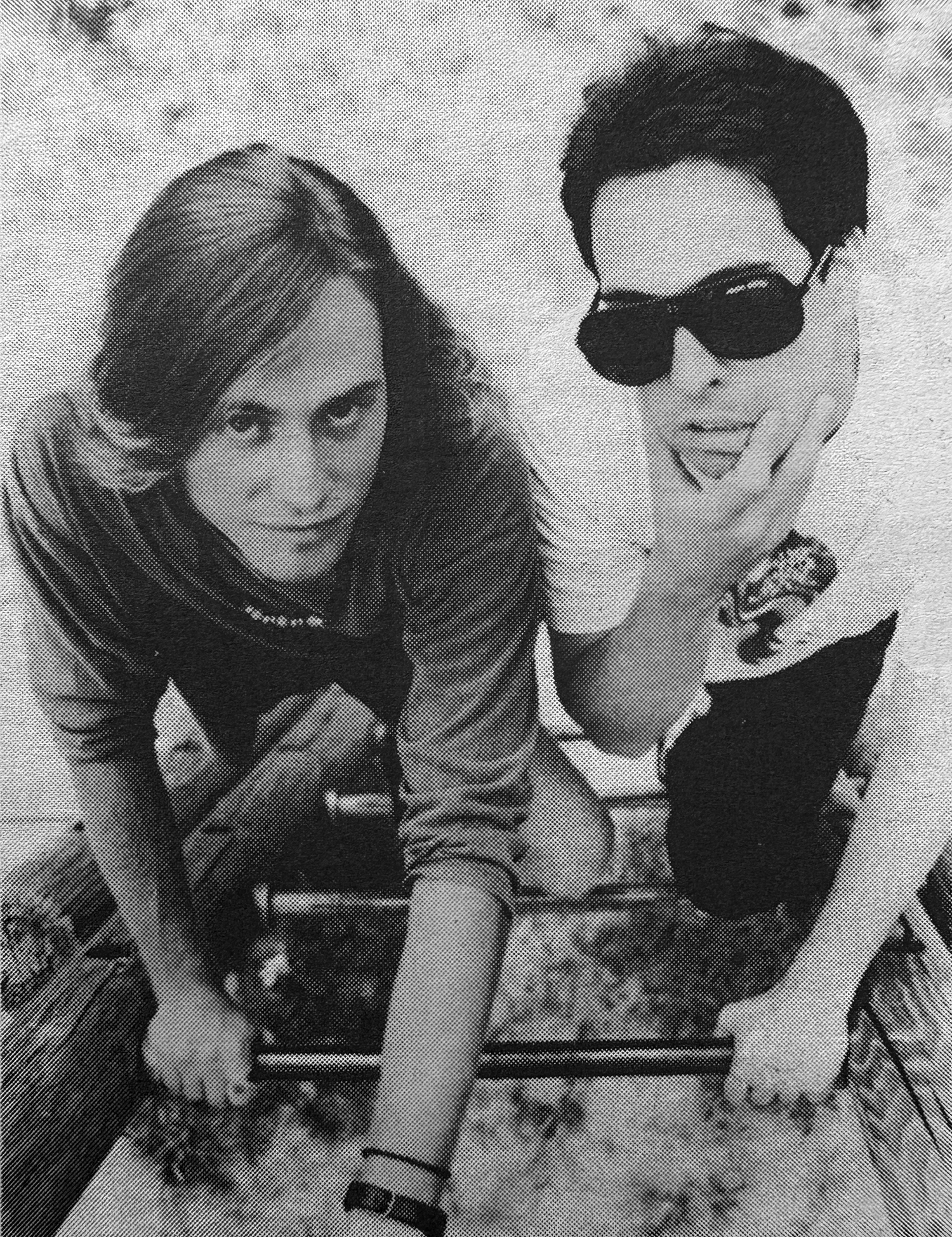
Industrial mechanics Claude Willey (left) and Mr. Spit (photo by Gregg Kirk)
By GREGG KIRK
Big Shout Magazine, October 1991
The industrial music scene in this area can best be described as being sort of like a Jehovah’s Witness — you may not know that it exists until it comes knocking at your door.
Yes, the Delaware Valley’s industrial scene may seem all but invisible at this point, but there are a number of factions who, though they aren’t attempting any door-to-door soliciting, are doing what they can to keep the music alive.
What exactly is industrial music?
Well, as in discussing most musical styles, each artist, critic, or musician is very passionate about his or her own definition; but in general terms, industrial music is an art form that combines the elements of a discernible beat (most often times a dance beat) with sounds produced by decidedly non-musical instruments (although conventional instruments are sometimes used). Everything from chainsaws to the sound of a smashing car, breaking glass, and sheets of metal being pounded has been used in this wide-open musical form. It was in this genre that the use of sampling was pioneered, being broadened and stretched by bands who are doing everything from trying to cross the music over into mainstream with pop dance beats, to combining a grouping of sounds that most listeners would not even consider music at all.
So where can you find it in this area?
As tiny as it is, there are actually two types of scenes to look for — the live scene and the dance/club scene, and what follows is a breakdown of the Delaware Valley’s industrial strength music…
Dead or Alive?
When talking about the live industrial scene in this area, especially in Delaware, you’ve got to talk about N.T.S. Records president and Batz Without Flesh member Claude Willey.And when talking about Claude Willey, you’ve got to mention controversial artist/frontman and anti-censorship proponent Mr. Spit.
Ever since the two met and hit it off in the fall of 1987, they have helped each other’s careers, played in each other’s bands, and ultimately teamed up to become the most prominent driving force in the support of industrial music in the area.
Before getting into what they are doing currently, it’s necessary to rehash what they have already accomplished.
Willey put out his first album, Batz Without Flesh, in 1986, which was followed by a mini-LP of the same name in 1988. He formed his own label, N.T.S. Records, and has been distributing units in impressive numbers for his own band as well as other artists to buyers in Europe and the West Coast for years. In 1989 he had two releases, A Million Bricks and No Memory, but as of last month, he penned a record deal with Body/Antler Records and is teasing a surprise release at the end of this month.
Spit’s first record, Thrust and Disgust, also appeared in 1986, and in many ways, his musical career has paralleled Willey’s. Instead of running his own label, however, Spit owns and runs Libido Studios — an eight-track facility that has been the recording home of such alternative bands as Token White Boy, Carnal Ghia, and Otto’s Vengeance.
He followed his first release with a 16-song record titled Anger in 1987, which in turn was followed by a three-song 12-inch called Road Pizza and a seven-inch 45 r.p.m. record named Flinch the next year. You Would if You Loved Me was his next release in 1989, and this year he signed a P&D (production and distribution) deal with Cargo Records, who are now distributing his current album, Persecution of Genius.
While both artists have an impressive resume, a long list of accomplishments, and have reached a certain level of success in musical markets in Europe and in California (which has included a rousing tour of San Diego, L.A., and San Francisco last summer), how is it they are relatively unknown in these parts? That question was posed to both N.T.S. labelmates one hot, sticky, and mosquito-infested night during an interview in the pseudo park area of Willey’s apartment complex in Newark, DE.
“I don’t know how it all happened,” admits Willey. “But it started when I hooked up with domestic distributors who in turn traded with overseas distributors. Once those distributors came across the stuff, they contacted me directly.”
“It’s cool to get a record from another country,” smiles Spit. “And that was the big gag with Road Pizza. We were giving them to distributors domestically like Dutch East India or whatever, and somehow John Peel in England got a hold of it — he’s got this big radio show over there, and he was playing it and everyone wanted to get a hold of it.”
“And then this big distributor in London ordered tons and tons of it,” laughs Willey. “They were, like, calling me every day ordering more Road Pizzas, and I was telling them I didn’t have any more.”
“It sold like a bitch and we didn’t have the capital to press more,” says Spit.
“And they were going to give us money, too,” laments Willey. “But then three months after that happened, their whole company collapsed, and they owed me a lot of money. They bought all these Road Pizzas and probably paid for about half of them.”
If listening to Willey’s and Spit’s tales of overseas success make it all sound easy, listening to their stories of the fading local scene are a splash of cold water on the subject.
“At one time there was a budding scene happening,” says Willey. “Sinister Attraction were around, we were doing stuff, and then there was another band called Zenophon who were doing stuff. We would all do shows together. This was about two years ago, and then it all fizzled.”
According to Willey, the industrial scene in Philly went limp about the same time.
“At one point all of the industrial bands sprouted out of these same bunch of art school people, and they just kept growing until all of a sudden the scene stopped at one time,” says Willey. “We opened up for one of the bigger bands called Orifice in ’87 at the Khyber Pass, and it was their final show. They were one of the last ones in Philly. We were playing Revival all the time! Every month, tons of people would come out. We opened for Psychic TV at this time, and now nobody cares. The over-21 crowd couldn’t give a shit. They’re just happy going to the Khyber and getting drunk. It seems like the industrial crowd is a younger crowd.”
It’s There If You Look For It
Someone who would agree wholeheartedly with Willey’s words is the Trocadero‘s DJ Wad, who spins industrial music (“everything from Front 242 to Ministry”) on Wednesday and Friday nights at the club. Revolution, an all-ages industrial dance party from 8 p.m. to 2 a.m. occurs on Wednesdays, and Blitzkrieg, an over-21 industrial dance party, is featured on Fridays. According to Wad, the former is more successful… so far.
“During Revolution, there’s a lot of kids between 18 and 20, who are hip to the new music,” says Wad. “But a lot of the new stuff, they’re afraid to dance to. They have to listen to it a few times before they’ll move to it. They’re more into the techno-dance stuff like Depeche Mode and New Order right now.”
Wad intimates that Revolution is currently drawing as many as 1,000 industrialites on a Wednesday night, while the newly-implemented Blitzkrieg has been attracting between 200 to 300 drinking-age patrons. So far, both dance parties are practically the only show in town for aficionados of industrial music.
As far as the live scene goes, the same is true. The club has featured such national acts as Pigface, K.M.F.D.M., Thrill Kill Kult, Meat Beat Manifesto, Front 242, Sisters of Mercy, and Consolidated, to name a few.
“The Troc’s the place to be,” says Wad in reference to national industrial, but when it comes to the local scene, he reasons that the lack of clubs supporting the art form have all but killed it.
“I think people are afraid to promote it because they never had a place to promote it — until now.” he says, and he adds that he’s willing to play local industrial releases during his shows, especially if the bands give him plenty of promotional material and records to give out to the crowd.
So where is the future of industrial music headed?
According to all three industrialists, even the national and international scenes are being corrupted by newer bands that are drawing from the original industrial bands.
“The biggest thing now is the electro-dance industrial stuff,” says Spit.
“And people think that’s industrial music,” says Willey. “But the whole industrial music revolution is, like, totally over,” he continues. “It was started by Throbbing Gristle, Einstürzende Neubauten, and all those bands…”
“It was anti-music,” interrupts Spit. “It was noise, sounds, and rhythms generated to be non-musical — to be sort of like a rebellion against regular music and to reflect the sounds of the times… the industrial era. And it’s all over now.”