Marvel Comics: The Case of the Post Modern Heroes
By TOM WATKINS
Big Shout Magazine, December 1991
Marvel Comics is repackaging their back pages. The first Marvel Masterworks shames their current work, which is part of the irony of Marvel. A tiny company accidentally created “The World’s Greatest Comic Magazine” (The Fantastic Four) in 1961. Now, the “World’s Biggest Comics Company” can’t match its own rookie work.
Masterworks collects the first 10 issues of The Fantastic Four and The Amazing Spider-Man into comic-book sized hardbacks averaging 250 pages. Both are joyous examples of commercial, mainstream comics striving for something better than a throw-away bit of fantasy and violence. If you read these comics in their original 1961-64 incarnations, this will provide you with a nostalgic romp. If you’ve never read comics, here’s a great place to start.
Stan Lee wrote his heart out on these stories, brilliantly supported by artists Jack Kirby (FF) and Steve Ditko (Spider-Man). Both cartoonists co-plotted and developed their strips into uniquely personal statements. Kirby’s stories are full of gadgets, violence, and larger than life characters. Ditko’s work details people — people in trouble, people in triumph. He favors small, busy panels depicting conversation and facial details.
Lee’s scripts are dialog-heavy on Spider-Man and spartan on Fantastic Four. Both books find their own pace and style. Lee favors melodramatic captions on both series, but they’re heads above the leadenly mechanical standard of the time. Fantastic Four leans toward inter-group dynamics. Spider-Man follows an extended, soap opera-like supporting cast. Lee’s ear for dialog is superb, especially slang and humorous repartee. This is his best work, and it sparkles.
The $29.95 price tag per title is a pittance compared to the $10,000 or so needed to collect the originals. Unfortunately, Masterworks‘ ultra-white, glossy paper over brightens the art, as do very dense color screens. This loses the “dotty” comics look playfully enshrined by Warhol and Lichtenstein‘s pop-art paintings. Coloring varies from faithful to the original to totally redone schemes.
Most, if not all, of the original art for these stories has been lost; they survive only in photostats, with varying degrees of fidelity. Quality varies, but is good overall. There are also some lost footnotes and inaccurate or incomplete credits that should be corrected.
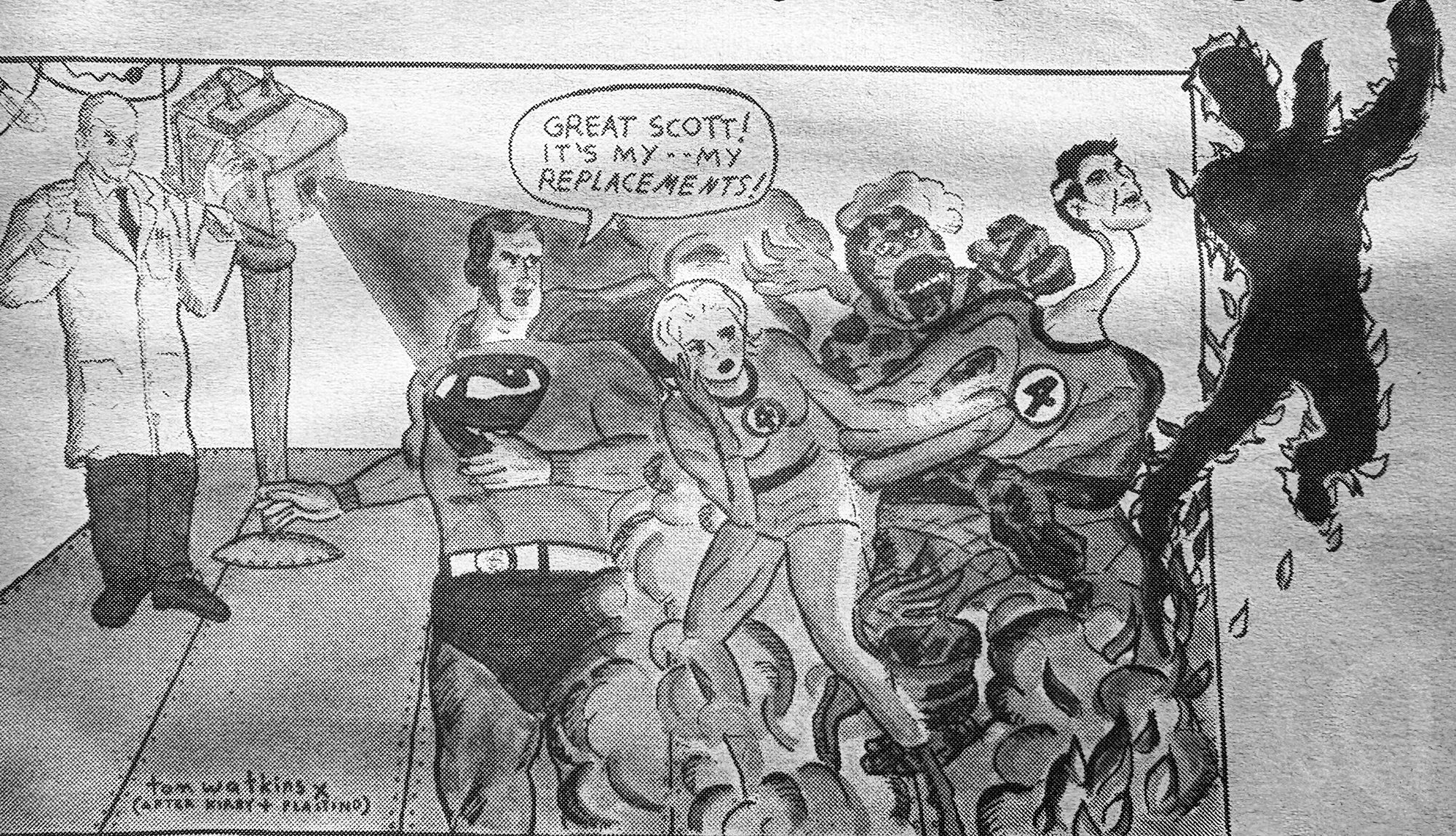
The Fantastic Four defend Earth from assorted menaces — when they’re not bickering. Three of the members could almost pass for comic book normal in 1961 — flying, stretching, and invisibility were old hat, even then. But their lumpy orange strongman, the Thing, was something new. The tension created by his brooding presence threw the comics rule book out the window.
Mad scientists created monsters — not brilliant and patriotic inventors like Reed Richards. His rocket flight with fiancee Sue Storm, her teenage brother Johnny, and pilot Ben Grimm was supposed to “beat the Reds into space” in August of 1961 — not expose them to mutating cosmic rays. Like a hulking albatross around Richards’ rubbery neck, the Thing took the fun out of saving the world.
The Fantastic Four were different. They didn’t worry about secret identities — it’s hard to conceal an ICBM in a New York City skyscraper headquarters. They worried about communism and suffered from money problems. Richards prophetically lost his patent income in the stock market in a 1962 issue. Sue Storm even lived in the same building as her fiance. They didn’t concede to the genre’s demand for costumes until the third issue. And unlike Superman, a comb-able spit curl and glasses wouldn’t go far in concealing the Thing’s identity from a curious and frightened world.
Kirby’s art is rushed but vital. The group changes and evolves tremendously in the year and a half collected here, and their rise to success makes for fascinating, “fantastic” reading.
Spider-Man sums up decades of hero comics with energetic grace and invention while satirizing the genre. Its hero is neurotic, problem-plagued but super-powered Daily Bugle photographer Peter Parker. He has a literal identity crisis — his publisher J. Jonah Jamison (not jovial Perry White) is a paranoid nut, convinced that Spidey is a crook, menace, or worse. He tabloid crusades Spider-Man’s arrest, while Parker makes a living from photos of his alter god captured via “automatic camera.”
Stories display genuine pathos at times. Characters die, experience personal loss, and function with a sense of reality missing in most comics, both before and after. Snappy dialog, well-structured plots, and vibrant graphics make these stories classic.
Later stories of both comics series are also available in the same format. Marvel recently took pity on the less wealthy among us an issued a slick paper, single issue reprint of the first Fantastic Four issue and several other titles.
Tom Watkins is a 1991 Delaware State Arts Council fellowship awardee for journalism.