New Music Seminar 12: Ridin’ the Storm Out
By GREGG KIRK
Big Shout Magazine, August 1991
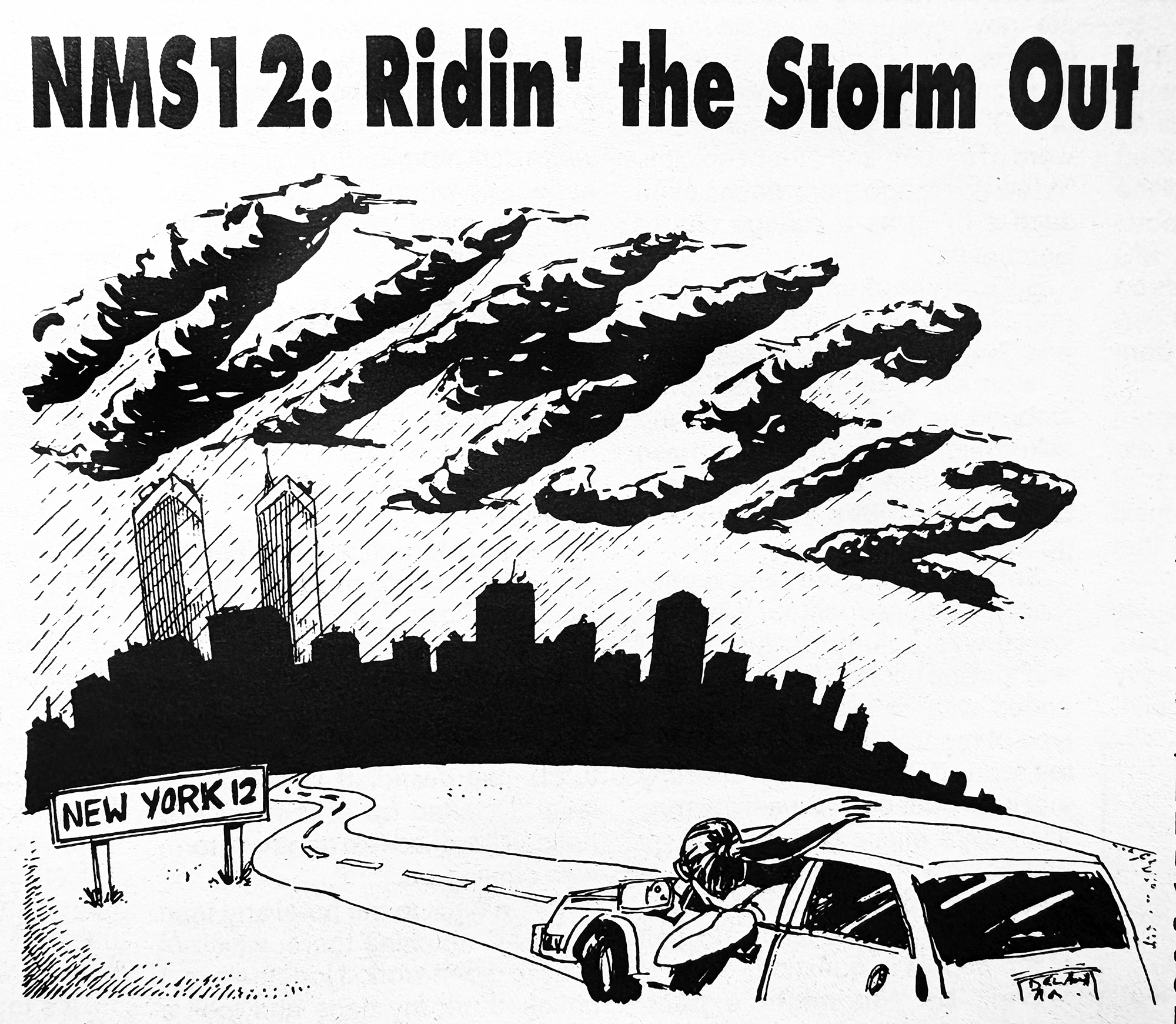
I was northbound somewhere on the New Jersey Turnpike when I hit the edge of the storm. I was driving at breakneck speed, listening to loud music, and drinking a canned beverage — trying to desensitize myself on the way to the 12th annual New Music Seminar. I figured the best way to face the full brunt of New York City and the only way to brace myself for the hordes of schmoozing, blood-sucking flies that I would encounter at the conference was to nub every nerve ending of my body.
In the middle of July, New York City burns like a candle, summoning every kind of musical insect from across the country. I was just one of them. We would all be converging on the city at the same time, and I wasn’t looking forward to that prospect. And though I can’t say I was eagerly anticipating spending almost a week in the middle of Manhattan during the hottest time of the year, I wouldn’t have wanted to be anywhere else. There’s something to be said about being in the center of something groundbreaking while it happens. From July 13-17, some of the most amazing bands from literally across the globe would be playing in one city and one city only. I could not pass up the opportunity.
The vibrations of the road and the sound of the music put me in a driving trance, and I mentally prepared to face the citizens of the Big Apple…
Q: How do you ask a New Yorker for the correct time?
A: Excuse me, are you wearing a watch or should I just go screw myself?
But the storm’s intensity came on unexpectedly, forcing me to slow to a crawl. Visibility was about 10 ft., and the shoulder was lined with vehicles who had opted to ride out the storm. Each time I tried to speed up, the car’s tires hydroplaned, making the vehicle absolutely uncontrollable for short bursts. With every push of the gas pedal, my body sent commensurate amounts of adrenaline into my veins. It was the worst storm I had ever encountered on the road, and I was hurtling headlong into it. I felt that somehow it was an omen.
The Seminar
The New Music Seminar has become the victim of its own success. In fact, it bears a remarkable resemblance to MTV. Remember when the music channel was free and played cool videos you’d never seen before? Well, NMS had its own humble, grass-roots beginning as well.
It started as a delegation of not more than 200 people some 12 years ago (i.e. 1979), and the focus of the conference was to bolster the new music scene. This year, the NMS staff expected more than 8,500 delegates (most of whom paid close to $300 a head in registration fees). Not only has the attendance swelled, but its focus has blurred in the process. While there is still a healthy contingent of alternative music sorts, virtually all aspects of the musical spectrum are evident on the busy tradeshow floor and in the workshops and panel discussions. The funny thing is, almost all the people at the seminar complain about this, yet they keep coming every year like salmon to spawn.
One thing must be said in defense of the conference, however, though crass capitalism and shameless marketing ploys abound, NMS remains the largest gathering of musical minds in one place, at one time, in the world. And there are still enough right-thinking people present, who genuinely want to better the new music scene and to give a grain of faith to the future of music. You just have to look a little harder.
The Showcase
One thing we trumpeted last issue was this magazine sponsoring a showcase at Kenny’s Castaways in Greenwich Village on Sunday, July 14 during the seminar. Local bands Napalm Sunday, Dandelion, the Killtoys, Rubber Uglies, and Deadlyne were slated and everyone involved with these groups did their best to try to lure record label execs out to the show.
The day of the gig, I spent ample time in the “schmoozatorium,” a gigantic revolving bar located on the eighth floor of the Marriott Marquis, where the elite meet to eat… and drink and schmooze. There, I put a promotional flyer in the hand of any person who would take it, and I went on a one-man publicity campaign in an attempt to get as many seminar people out to the show as possible. This was made necessary by the fact that our showcase had been left out of all of the NMS literature and update material, and we were a little nervous about attendance. The only thing heralding our event was a lone Kenny’s Castaways’ ad in a “New Music Nights” tabloid that had all of the bands listed except for Napalm Sunday.
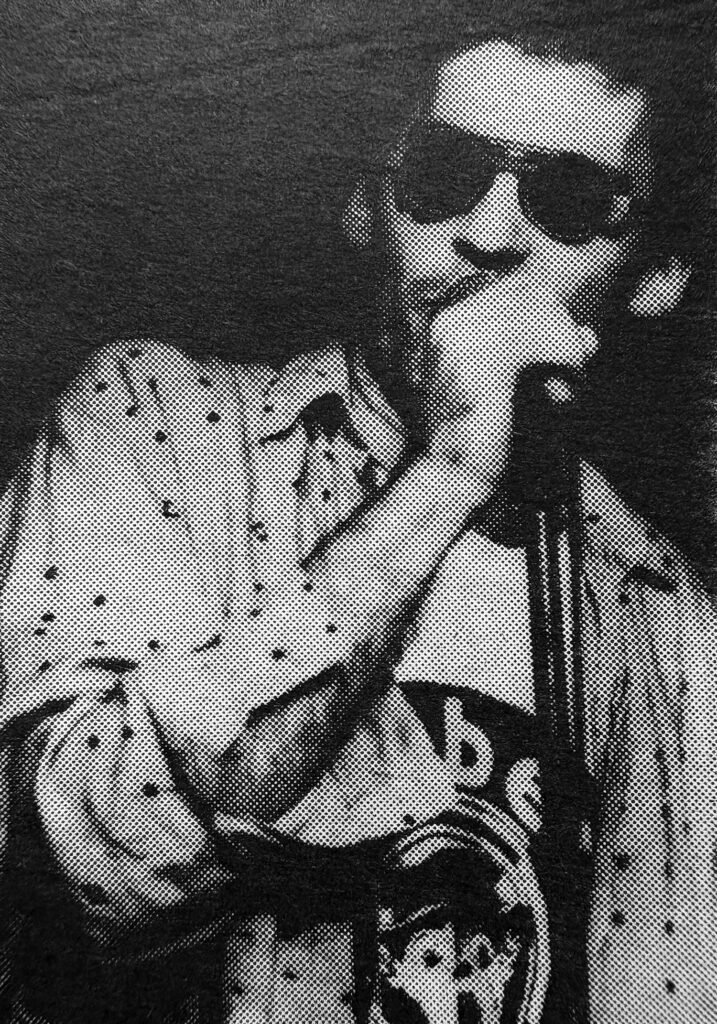
Troy Tatman of the Rubber Uglies takes part in Big Shout’s five-band New Music Seminar Showcase at Kenny’s Castaways in Greenwich Village, NYC (Photo by Deny Howeth)
To hedge our bets, we had organized a bus trip to the venue for fans of the aforementioned bands, and at the appointed hour, I took a cab to the venue and met them and the remainder of the Big Shout staff. The all filed off the bus, bellied up to the bar, and gave more than enough drunken support for the groups scheduled.
Every one of the bands played their guts out, but it was hard to gauge any kind of impact they had on the locals and the handful of label people who showed up because of the incredible turnover of patrons in the club. A band would start playing, and by the time they’d finished their hour-long set, at least half of the people in the club were not those who were there half an hour before. For what it’s worth, however, Sean Lennon caught the tail end of Deadlyne’s set at the end of the night.
The Panels
The main thing to look forward to every year at the seminar is the incredible slate of bands playing each night at dozens of different clubs across the city. Unfortunately, because of scheduling problems and lack of funds, I was only able to see two groups play during the “New Music Nights.”
Luckily, I was pleasantly surprised by a few panels I attended. It was by chance that I happened upon probably the most interesting panel I have ever witnessed, which was sponsored by Seconds Magazine. The panelists included moderator Steve Blush (from Seconds Magazine), Bill Gould (bassist for Faith No More), Bruce Pavitt (from Sub Pop Records), Steve Martin (from In-Effect Records), Lauren Spencer (from Spin Magazine), MC Serch (from 3rd Bass), Pat Dubar (vocalist from Mind Funk), and Reed Mullin (drummer from Corrosion of Conformity).
The audience was packed to overflowing with oh-so-hip types ranging from rappers, to metalheads, to post punkers. The theme of the panel discussion was, “Rap, Metal, Alternative: We’re All in the Same Gang,” and it started off innocently enough with all of the panelists taking potshots at obvious targets like Vanilla Ice, MC Hammer, Nelson, and New Kids on the Block — “artists” who are certainly not in any gang of the panelists.
Things grew more heated when MC Serch launched into an extended diatribe about the lack of lyrical integrity of most of the music on pop radio. His stance was that white people had no business playing or even copying black music (never mind the fact that rappers consistently sample white heavy metal like Led Zeppelin, Heart, and Black Sabbath). He also held that black artists weren’t beyond reproach — rappers like MC Hammer and Young MC, who rap about “pies and cakes and going to the principal’s office” are a disappointment to young kids who grow up on the streets witnessing death, prostitution, and drug addiction.
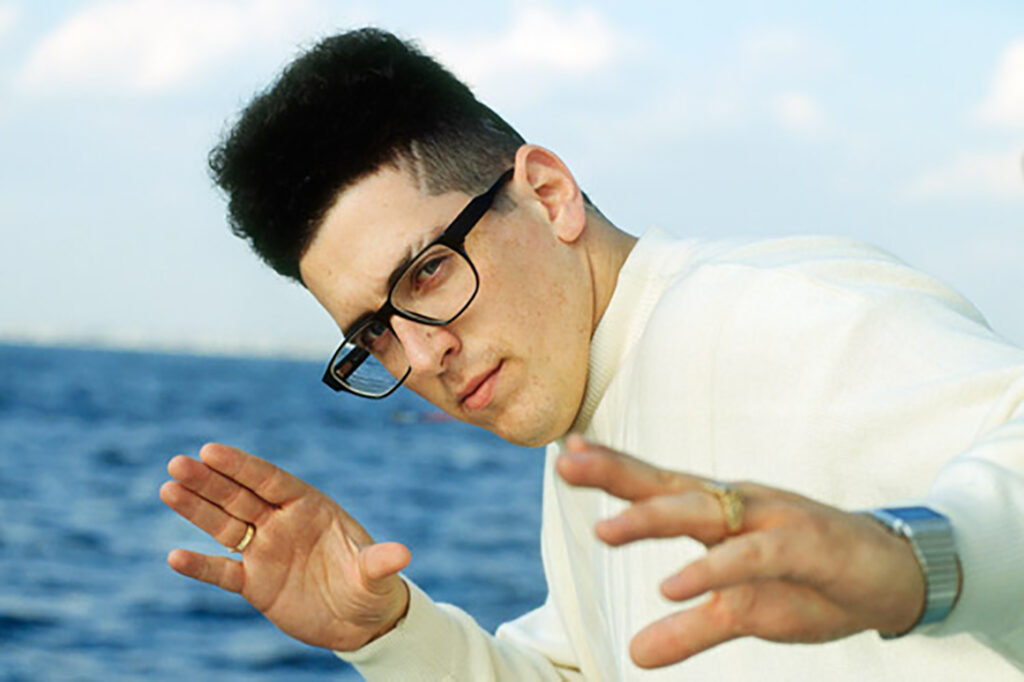
MC Serch of 3rd Bass
He also reported that the overall alternative music scene is improving with “hipper” people and ex-musicians working at labels, who are now giving the artists more freedom. Not only this, but the music is getting out to the people in spite of AOR (Album Oriented Radio) radio. It’s happening via college radio, word of mouth, and other vehicles. “A few years ago there wasn’t even such a thing as a college chart,” Serch said.
But every so often, Serch couldn’t resist taking jabs at “Vanilla Wafer” and “New Kids on the Crack” until a woman from the audience stepped up to a microphone and asked him, “Instead of tearing down artists you think are bad, why not build up the ones you think are good?”
Serch’s response and vehemence was unexpected. What followed was a flurry of “fuck yous” and “get that bitch off the mic,” which ended with him saying, “It’s that type of mentality that is destroying the scene!” He went so far as to say that it was our duty, if we were truly alternative music devotees, to try and destroy these artists and ruin their record deals. In other words, he was calling for an all-out boycott of the people in question.
Well, as you might imagine, someone raised the question, “Who are you to say which artists are good or bad?”
Serch shot back, “Is there anyone in this room who likes Vanilla Ice?” Of course there wasn’t. But the thing that bothered me was that Serch’s words smacked of censorship of a certain kind. I wanted to stand up and shout that even if these artists were removed from radio playlists, their audience (girls between the ages of 12 and 16) were not going to flock to artists rapping about drug-addled prostitutes.
Lite rappers like Vanilla Ice and MC Hammer, bands like Nelson, and other pop metal and “dangerous animal bands” (as Serch calls groups like White Lion, Glass Tiger, Whitesnake, etc.), and any other deplorable artists including 2 Live Crew have as much right to perform music as any other artist. Trying to stop them from doing so shows a closing of the mind that I am afraid to say is becoming increasingly evident around these parts as well. It was a dark moment in music history, especially when Bill Gould voiced his agreement, and the rest of the panel followed.
The Storm Returns
Later that day, I attended an ASCAP seminar whereupon unsigned artists had their recorded material played over a P.A. system and then critiqued publicly in real time. That was interesting.
I left the Marriott and reached for my wallet to check on my monetary situation. To my shock, I found that I had barely enough money to buy a train ticket home, but after taking a few cabs in search of Big Shout staffers, who had more money, my funds had dwindled to a pathetic level. I looked up at the sky and noticed it looked like another storm was coming on.
I went back to the hotel and tried the MAC machine there, which of course didn’t work. Nonetheless, I checked out my bags and took a cab to Penn Station. After trying every means to get cash for my train ticket, I was left with only one alternative — to use my overloaded credit card.
I shambled from the cab, with bags hanging from every limb, and limped out of the gathering gloom into the train station, still not knowing whether I would 1. make the last train out of New York and 2. be able to buy a ticket in the first place.
My fears were relieved when I noticed on one of those little TV monitors that the train to Philly was delayed. I was also happy to find that I could in fact buy a ticket with my credit card, but the person behind the counter informed me that the train to Philly was delayed all right — by an hour and a half. I threw myself in a chair and let my bags tumble around me.
On the way home that night — while I tried to get comfortable in a seat whose back wouldn’t lock, forcing me to not put my full weight on it lest I clock the person behind me — I thought about all we had accomplished. We had put a lot of effort into this thing, and we had come away with… well, I guess we felt a little like a perversion of that famous quote by Julius Caesar.
We came, we saw… we left.