Paying the ’90s Piper
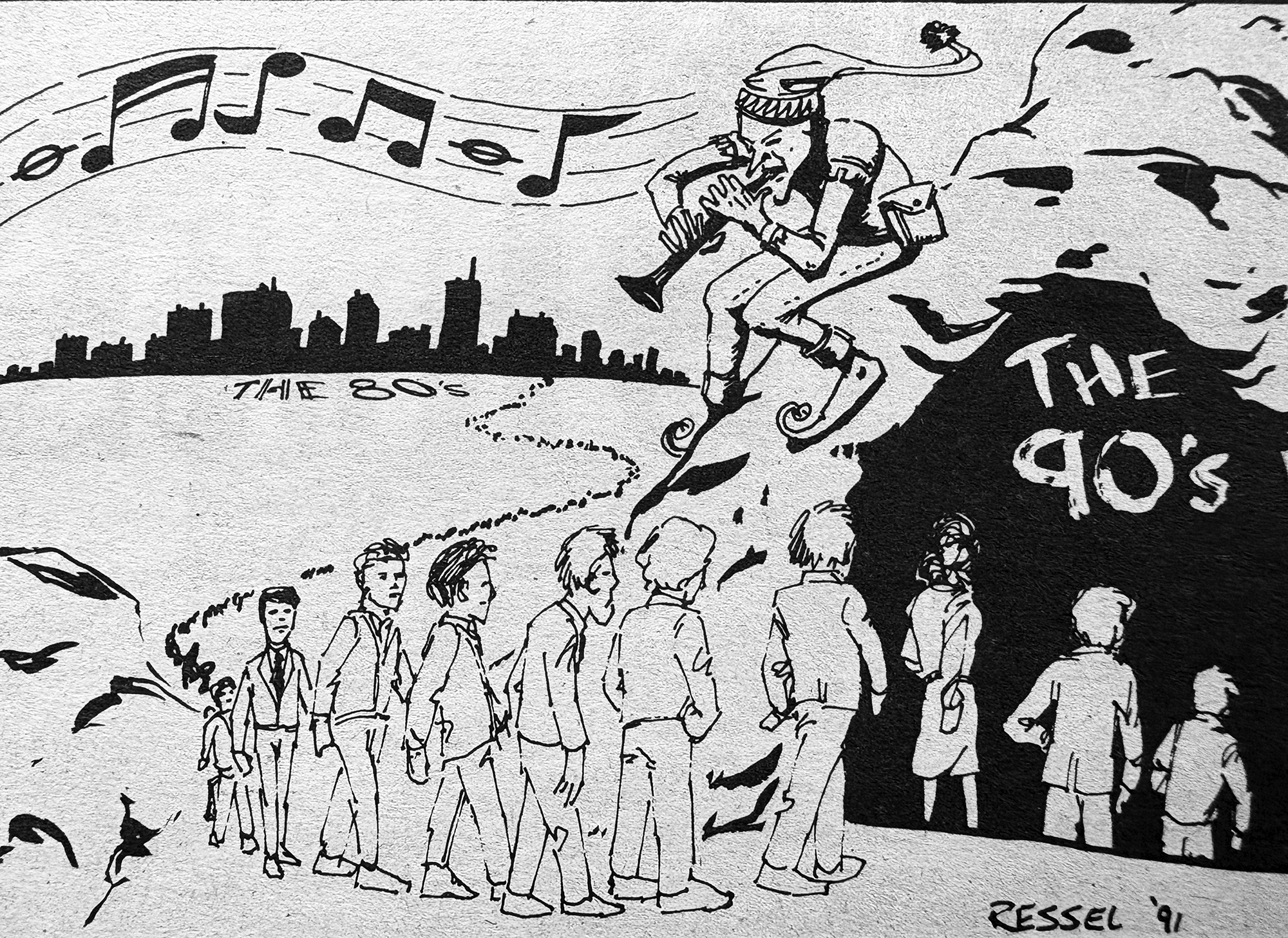
Society Seeks Absolution For Sins of Yesterday
By CHRIS PURDY
Big Shout Magazine, January 1992
I sat at home today, on the balcony of my second-floor apartment, staring across sullen tar roofs of adjacent brownstone homes to the Wilmington skyline and the Chase Manhattan debacle that dominates it. Newspaper headlines herald the laying off of hundreds of DuPont workers and eerily predict the demise of the local economy. For every thousand DuPonters given the pink slip, The News Journal warns, 22 downtown businesses fold.
The Chase building shines today, the late afternoon sun glistening, omnipotently against the metallic blue glass. Yet despite the fact that today is Monday, that day which this city of bankers and brokers most reveres, Corporate America seems none too smug.
Down at the coffee shop on Union Street, a sense of prophecy seems to rise amongst the steamy Afghani blends. The gray pinstripes across town thank their lucky stars they didn’t graduate with that MBA 10 years later, and all the java house regulars patiently await their chance to return every contemptuous leer of the past decade.
What is happening today is that the ’80s — that decade which held its ideals so clearly and easily within its own chronological boundaries — is being forced to pay its mortgage. Painfully, that hairy and materialistic creature known as the Business World is finding that it too must balance its check book. The irony is impeccable, and the liberal cynics basking in the warmth of a million lava lamps are savoring every minute of it.
Isn’t there a problem here? This is no time for polarized ideologies to be drifting even further from the rational epicenter. It seems that one of the greatest obstacles to be overcome in these times of uncertainty and potential crises is the wall of party politics. Congressional liberals and their ideologically compatible business leaders, if the latter exists, must put a stop to the gloating “I told you so’s.” Collectively, we now have to face the music, and the tune promises to be ugly enough without petty bureaucratic infighting throwing us even further off key.
Nonetheless, we can no longer afford not to acknowledge the truth. America turned its back on the need to invest in research, development, and education so that we could shine in the limelight of the sunny day, and now we find the results of our economic hedonism looming uncomfortably near. All those Ronald Reagan and Lee Iococca commercials of the mid-’80s now seem oddly embarrassing. We sit and wonder what was really happening when our hearts, swelling with pride, watched blue collar Amierica striding proudly towards the Chrysler factory, the resurrected flag waving in slow motion in the background. We voted with those proud hearts of ours; we spent with them and we lived with them. We had a ball. We just never stopped to think.
So now we turn to face the mouldy ’90s, and through the haze and ambiguity we become increasingly aware of a collective panic being brought on by our realization that we are over-extended on credit, over-educated, and under-paid, or over-qualified and jobless. And that’s just those of us who are lucky; these are the worries and problems of those of us who thought they would never have problems.
If the well-educated, career-minded segment of society can’t make ends meet, what can be said about the rest? What about those who have been victims of a 92% slash in federal public housing assistance, the nomination of a team of Supreme Court justices intent on reversing 30 years of civil and womens’ reforms, those whose parents were sucked under so rapidly in the first wave of the 1980s economic polarization that the only sense of family that remains is provided by the warped bonds of the inner-city drug structure?
Today we are beginning to see the tip of the iceberg. What people don’t seem to comprehend, despite being bombarded daily with the ugly statistics, is the ills currently plaguing our society — homelessness, AIDS, racism, recess — are colliding with such velocity so as to jolt our nation, and disproportionately the urban Northeast, to an extent it has never quite experienced.
Pay this some attention. Certainly, we have experienced recession before. But when our economy last faltered, a decade or so ago, was the national financial crunch augmented by two million homeless who also needed to be supported? When racism last caused our inner cities to erupt, was that violence intensified by the anger boiling over from the crack-strewn neighborhoods? When unemployment last rocked the very foundation of the working class, were we led by a president who felt the best way to address such a problem was to veto a congressional bill designed to buy these desperate families some time?
So here we are — myself with notepad in hand — yourself reading, hopefully concerned. I find myself staring at narrow yellow lines and realize that once again I’m communicating through stylistic bullshit prose, my message blurred by symbolism and personification. I wonder why the facts don’t glare off my page in black and white as clearly as they do off the street. There are times when I wonder how many stupid mistakes the American people have to make before we begin making decisions based on rationality and clear thinking, rather than our emotions.
We must be the most gullible people on the face of the Earth. The riches, certainly, but also the most gullible. Although everyone knows how easy it is to be a Monday morning quarterback, and that we are all astonishingly brilliant in retrospect, I cannot help but wonder how we ever could have doubted the inevitability of our current economic situation.
It all seems so crystal clear — from roughly 1981 until 1989, we borrowed, spent, ran up or Visa bills, accelerated the national debt to the tune of three trillion dollars and pulled money out of research and development to finance our insatiable desire for The Good Things In Life. We made a pact with the devil. Now, come Judgement Day, we claim we didn’t know any better. We thought it made sense, or so the argument goes, to cut taxes while simultaneously increasing spending. We thought this would balance the budget.
George Bush knew better. He correctly labeled such fiscal idiocy “voodoo economics.” After he lost the 1980 Republican nomination, however, and was chosen by Ronald Reagan as his running mate, George suddenly began to see the light. “Sound and necessary fiscal policy” became the new buzz phrase, George Bush, wishy washy? Inconceivable.
We live in a nation of idiots. We deserve everything that’s happening to us — there’s no denying that. Any country that elects Ronald Reagan to the most powerful position in the world — not once, but twice — deserves to die a slow and painful death.
Furthermore, George Bush has proven himself to be entirely insensitive to the needs and wants of the working class. If you can’t see that, you’re a fool. If you still believe the president is nursing our nation towards a “kinder and gentler” status, you’ve been sadly and easily deceived. If you believe Clarence Thomas doesn’t have an agenda, and that the most personal and fundamental right of a woman — control over her own body — is not at risk, then you have been either hopelessly gullible or living under a rock.
While the point here is not to offend, it must be acknowledged that the social and political ignorance of people in this country is astonishing. “Lesser” nations, where the people are better educated and more conscientious, laugh at us. Such is the ugly truth. The time has come to begin making intelligent decisions about our nation’s leaders and policies. We all have the power — indeed, an obligation — to influence the future of this country. It is time for us to get off our collective asses and participate intelligently in the governmental process.
Write to Senator Roth and ask him why he refuses to support extension of unemployment benefits. Write to the president and tell him of your anger at his attempt to politicize the Supreme Court. Find some cause you care about and get involved. And of course, vote. Vote after making informed decisions; vote after determining where the candidates stand on the issues. Don’t let your vote be bought by catchy, patriotic song and dance commercials. Don’t be influenced by rumors unless you truly believe that the marijuana cigarette John Q. Candidate may have smoked 20 years ago in college will honestly skew his ability to govern honestly and intelligently.
And lastly, if you don’t vote, don’t bitch.